Leave Your Message
0%

China Top 10 Pulp Tableware Suppliers for Global Buyers starts with a pretty practical question: which suppliers can actually deliver products that are safe, consistent, and scalable?

Pulp tableware is no longer just a niche alternative—it's becoming a regular part of foodservice packaging. Smithers' report, The Future of Molded Fiber Packaging to 2028, points to molded fiber as a growing segment, helped along by plastic reduction targets and foodservice demand. Grand View Research also shows strong expansion in the global molded fiber packaging market, though estimates can differ depending on how products are defined and which regions are covered. And that difference really matters. A supplier might brag about rapid growth, but still give you very little proof about factory capacity, where materials come from, or export track record.

China is still a key manufacturing base. It has paper-processing know-how, equipment availability, and wide production networks all in one place. The suppliers in this guide are looked at through practical buyer criteria—things like product design, bagasse or recycled-paper inputs, forming technology, drying control, quality documentation, and shipping reliability. Certifications such as ISO 9001, BRCGS, FDA food-contact compliance, and relevant EU requirements should be checked directly, not just taken at face value. A certification name alone doesn't tell you much.

Often, small details show whether a factory is really on top of things. A clean rim, even wall thickness, dry carton, and stable nesting ratio can cut down on complaints and freight costs. Buyers should also ask for migration testing, batch records, and independent lab reports. Some market rankings sound very confident, but supplier data can change fast. Factory audits are still a must.

This guide compares ten China-based suppliers for global buyers who want evidence, not just nice-sounding claims. It also faces an uncomfortable truth: a lower price can hide higher inspection, tooling, or replacement costs. Good sourcing means asking careful questions, checking documented samples, and keeping your expectations realistic.

China Top 10 Pulp Tableware Suppliers for Global Buyers

China’s Pulp Tableware Industry and Global Market Role

China’s pulp tableware industry is supported by a large paper manufacturing base and mature converting capacity. The China Paper Association reported about 140.2 million tonnes of paper and paperboard production in 2023. This scale supports access to molded-fiber machinery, recycled paper inputs, and export logistics. However, paper capacity does not automatically guarantee high-quality Paper Pulp Tableware. Food-contact safety, moisture resistance, and production consistency still require careful control.

Professional market studies from Smithers identify molded-fiber packaging as a growing global segment, driven by foodservice demand and pressure to reduce conventional plastic use. China plays an important supply role because factories can combine tooling expertise with competitive manufacturing costs. Export buyers often inspect pulp origin, additive composition, compression strength, and water resistance. These details matter when a bowl carries hot soup or sits inside a humid delivery bag. Some suppliers still focus too heavily on appearance. That is a weakness worth questioning.

Tips: Request recent test reports, factory production records, and sample data from different batches. Check whether claimed compostability matches the destination market’s certification rules. Ask for performance testing at realistic temperatures, not only room temperature. The best supplier is not always the cheapest one. A stable process usually matters more than a perfect first sample. Reports from the China Paper Association and Smithers provide useful market context, but buyers should verify every technical claim directly with manufacturers.

How the Top 10 Chinese Suppliers Are Selected

Selecting China’s top ten pulp tableware suppliers requires more than checking export volume or attractive catalogs. The process begins with verifiable factory evidence. Auditors examine molding lines, drying rooms, wastewater controls, and batch records. A supplier should provide food-contact test reports, material declarations, and traceable production codes. These checks reflect ISO 22000 principles and practical sourcing experience.

Material consistency matters greatly. FAO data shows global sugarcane production exceeded 1.8 billion tonnes in 2022, creating substantial fiber resources for molded products. However, abundant bagasse does not guarantee reliable tableware. The evaluation measures fiber cleanliness, moisture control, thickness tolerance, and resistance to hot liquids. For a Sugarcane Pulp Tableware Box, buyers should also inspect compression strength and stacking performance. Small defects become expensive during long-distance shipping.

Market evidence supports disciplined selection. The Smithers report, The Future of Sustainable Packaging to 2028, identifies regulatory pressure and fiber-based formats as major packaging trends. Suppliers therefore need documented capacity, stable lead times, and experience with international compliance requirements. Samples are tested under realistic conditions, including refrigerator storage, microwave heating, and rough carton handling. The shortlist is not a popularity contest. No ranking is perfect, either. Factory data can change after an audit, and published capacity may exceed practical output. A reliable selection method must revisit records, question inconsistencies, and value transparent limitations over polished claims.

China Top 10 Pulp Tableware Suppliers for Global Buyers

How the Top 10 Chinese Suppliers Are Selected

Selection methodology: The chart presents a 100-point buyer-screening model for comparing pulp tableware suppliers. Food-contact compliance and production reliability receive the highest weights, followed by export readiness, customization, sustainability, and logistics capability. The model is designed for supplier shortlisting and does not represent individual company or brand performance.

Profiles of China’s Top 10 Pulp Tableware Suppliers

China’s top 10 pulp tableware suppliers show a broad manufacturing range, from small forming workshops to integrated export factories. This profile selection focuses on production evidence, not promotional claims. Key checks include bagasse sourcing, pulping control, mold accuracy, drying capacity, and batch traceability.

The market is expanding. Grand View Research valued the global molded pulp packaging market at roughly US$5 billion in 2022, with continued growth expected through 2030. Smithers also identifies foodservice packaging as a major application for molded fiber products. Within China, leading suppliers commonly operate automatic thermoforming lines, water-based processing systems, and in-house mold rooms. Their catalogs often include plates, trays, clamshells, and the growing Sugarcane Pulp Tableware Bowl category. Ask for actual cycle times.

The ten supplier profiles also compare export experience, factory audits, product testing, and documentation quality. Stronger companies provide migration reports, compostability evidence, dimensional tolerances, and carton-loading plans. Some maintain ISO-based quality systems, though certification alone proves little. A practical buyer should inspect rim smoothness, stacking pressure, oil resistance, and moisture behavior under refrigerated storage. Weak points remain. Color consistency can shift between bagasse batches, while deep designs may show uneven wall thickness. Samples should be tested before volume orders, especially when suppliers quote unusually low prices.

Materials, Product Types, and Manufacturing Capabilities

China’s leading pulp tableware suppliers usually work with bagasse, bamboo fiber, wood pulp, or recycled paper. Each material behaves differently during molding and drying.

Bagasse offers a smooth surface and strong commercial appeal. Bamboo fiber can improve stiffness, but supply consistency needs checking. Recycled paper may support circular sourcing, yet color variation can appear.

Common product types include:

  • plates
  • bowls
  • trays
  • cups
  • lids
  • hinged meal boxes

Buyers should inspect rim strength, nesting efficiency, leak resistance, and heat tolerance.

Small details matter.

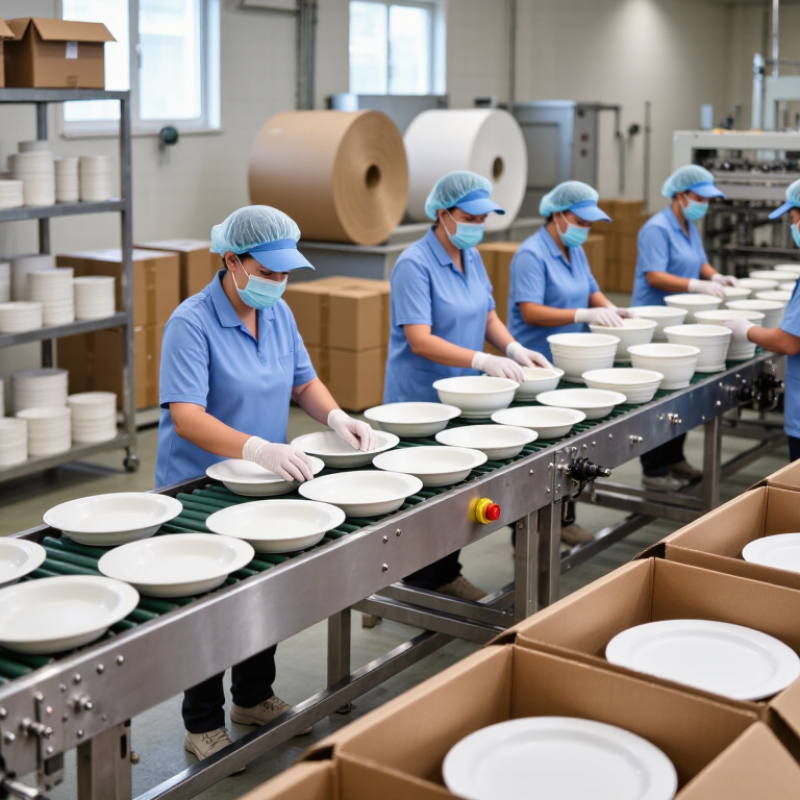
A thin corner can fail during transport. Many factories use molded-fiber forming, hot pressing, trimming, drying, and automatic packing lines. Some also develop custom molds for restaurant chains, catering distributors, and institutional buyers.

Manufacturing capability separates serious suppliers from simple trading offices.

Ask for production flow records, recent inspection reports, material declarations, and batch traceability.

Confirm tooling ownership, minimum order quantities, monthly capacity, and realistic lead times.

A supplier may offer attractive samples but struggle with stable mass production. That gap deserves attention.

In my assessment, the strongest factories combine experienced technicians with measurable quality controls.

Still, no supplier is perfect.

Moisture resistance, compostability claims, and packaging performance should be verified for the destination market.

A factory’s clean showroom proves little. Regular process checks prove more.

Quality Standards, Certifications, and Export Compliance

For global buyers, pulp tableware quality begins with controlled fiber, water, and additives. The FAO’s 2023 Forest Products Yearbook reported roughly 415 million tonnes of global paper and paperboard production. This scale increases the need for traceable raw materials and consistent manufacturing. Suppliers should provide batch records, moisture limits, grammage data, and migration-test results. ISO 9001 supports process control, while ISO 14001 helps document environmental management. Responsible forestry certification can also verify fiber origin and chain of custody.

Certification alone is not proof of food-contact safety. Buyers should request independent tests for heavy metals, fluorine, odors, microbial limits, and chemical migration. European shipments commonly require compliance with Regulation (EC) No. 1935/2004 and good manufacturing practice rules. United States shipments may require evidence aligned with applicable food-contact requirements. PFAS testing deserves special attention. UNEP’s 2023 Turning off the Tap report estimates that global plastic pollution could fall by 80% by 2040, but molded fiber is not automatically harmless or recyclable. Coatings can change the result. Compostability claims also need recognized test methods and clear disposal conditions.

Export-ready suppliers should maintain product specifications, declarations of compliance, test reports, packaging details, and lot traceability. A container may pass inspection, yet inconsistent moisture can still cause warping during transit. That weakness is often overlooked. Buyers should audit corrective-action records, not only certificates, and repeat testing when fibers, coatings, or production sites change.

China Top 10 Pulp Tableware Suppliers for Global Buyers - Quality Standards, Certifications, and Export Compliance

Supplier Profile Main Production Region Typical Product Range Primary Fiber Materials Food-Contact Frameworks to Verify Common Quality Standards Sustainability Documents Export Compliance Focus Recommended Buyer Checks
Supplier 01 Eastern China Plates, bowls, trays, clamshells Bagasse and bamboo fiber EU Regulation (EC) No. 1935/2004; EU GMP Regulation (EC) No. 2023/2006; US FDA food-contact requirements where applicable Dimensional inspection, visual inspection, leak testing, weight verification FSC Chain of Custody or equivalent fiber-origin evidence; compostability test report where claimed Commercial invoice, packing list, certificate of origin, HS classification, destination-country labeling Check migration testing, pulp source, coatings, carton marks, and batch traceability
Supplier 02 Central China Takeaway boxes, lunch boxes, meal trays Sugarcane bagasse and recycled paper fiber EU food-contact declaration; US FDA requirements; local food-contact rules in the importing market Food-contact cleanliness, compression strength, grease resistance, seal integrity FSC documentation where applicable; EN 13432 or ASTM D6400 testing only when the relevant claim is made Packaging-waste symbols, restricted-substance declarations, customs documentation Confirm whether barrier coatings contain PFAS, plastics, or other restricted substances
Supplier 03 Southern China Round plates, compartment plates, serving platters Bagasse pulp and wood pulp EU Regulation (EC) No. 1935/2004; EU GMP; applicable national paper and board requirements Flatness, edge quality, stacking performance, hot-food and cold-food suitability Fiber-origin declaration; independent compostability or biodegradability report where advertised Country-of-origin marking, product specification sheet, test-report consistency Request samples from the intended production batch and compare them with approved specifications
Supplier 04 Eastern China Cups, lids, soup containers, catering sets Molded fiber and bamboo pulp Food-contact declaration; applicable FDA provisions; destination-market chemical restrictions Liquid retention, thermal resistance, lid fit, odor and taste neutrality FSC or recycled-content evidence where claimed; third-party environmental test report Product labeling, packaging composition, customs valuation, transport protection Verify coating composition and test hot-liquid performance at the intended fill temperature
Supplier 05 Northern China Egg cartons, produce trays, protective food inserts Recycled paper pulp Food-contact suitability assessment for recycled fiber; applicable EU and national requirements Moisture resistance, compression strength, odor control, dimensional stability Recycled-content declaration and controlled-source documentation Recycled-material disclosures, packaging labeling, import documentation Check mineral oil hydrocarbons, inks, adhesives, and recycled-fiber contamination controls
Supplier 06 Central China Microwaveable meal trays and food-service containers Bagasse pulp with water-based barrier coating EU food-contact framework; applicable FDA food-contact requirements; coating-specific compliance evidence Microwave-use validation, oil resistance, dimensional tolerance, coating adhesion PFAS-free declaration supported by laboratory testing where required by the buyer or market Claims substantiation, packaging language, chemical-restriction compliance Obtain coating formulation disclosure or a suitable restricted-substance test report
Supplier 07 Southern China Custom-molded trays and private-label food-service items Bagasse, bamboo, and virgin wood pulp blends Food-contact declaration and migration testing for the final finished article Mold accuracy, wall-thickness consistency, stacking and drop testing FSC evidence for certified fiber; compostability certification only after product-specific testing Tooling ownership terms, approved artwork, barcode and carton compliance Audit mold maintenance, change-control procedures, and first-article approval records
Supplier 08 Eastern China Retail-ready plates, bowls, and multipacks Bagasse and recycled paper pulp Destination-market food-contact rules; final-product declaration of compliance Retail pack accuracy, barcode readability, appearance, count verification Fiber-source records and substantiated environmental claims Retail labeling, language requirements, carton dimensions, pallet configuration Approve artwork before production and conduct pre-shipment quantity inspection
Supplier 09 Central China Heavy-duty catering trays and serving containers High-density bagasse pulp EU and US food-contact requirements as applicable to the destination Load-bearing capacity, heat resistance, oil resistance, stacking strength Compostability, recycled-content, or renewable-material claims require product-level evidence Pallet stability, export carton strength, container loading, moisture protection Run transport simulation or drop testing for long-distance ocean shipments
Supplier 10 Southern China Full molded-fiber food-service programs Bagasse, bamboo, and wood pulp EU Regulation (EC) No. 1935/2004; EU GMP Regulation (EC) No. 2023/2006; applicable FDA provisions Quality-management procedures, sampling plans, traceability, corrective-action records FSC documentation, compostability testing, recycled-content verification where applicable Country-specific labeling, customs records, restricted-substance compliance, claim substantiation Review factory audit results, laboratory accreditation, batch records, and complaint handling
Buyer note: Certifications and test reports must be verified against the exact finished product, material composition, production site, issuing laboratory, and destination-market requirements. A general factory certificate does not automatically prove compliance for every pulp tableware item.

Pricing, Minimum Orders, and International Logistics

For global buyers, China’s pulp tableware pricing depends on fiber quality, product size, wall thickness, packaging, and order volume. Recyclable Sugarcane Pulp Tableware often has indicative FOB pricing of $0.03–$0.20 per piece. These figures are not fixed quotations. A realistic minimum order commonly ranges from 10,000 to 50,000 pieces. Custom shapes may require separate mold charges. Ask for a full cost sheet, not only the unit price.

Production usually takes 20–45 days after artwork, payment, and specifications are confirmed. Export cartons should protect edges from crushing and moisture. A small container can hold many lightweight cartons, but the final loading plan depends on carton dimensions. Buyers should compare FOB, CIF, and DDP offers carefully. They do not cover identical risks. Request carton measurements, gross weight, HS classification, packing lists, and food-contact documentation before booking freight.

Port congestion can change delivery schedules. It happens. Leave buffer time for seasonal delays and inspections. I have seen low-cost orders become expensive after mold fees, inland trucking, and destination charges appeared late. Forecasts are often wrong, especially for new markets. Confirm payment stages, replacement terms, and quality tolerances in writing. A pre-shipment sample inspection can catch uneven rims, weak corners, or poor nesting. It costs less than solving a container dispute.

How Global Buyers Can Compare and Choose a Supplier

China Top 10 Pulp Tableware Suppliers for Global Buyers

Comparing Chinese pulp tableware suppliers requires more than checking unit prices. A lower quotation may hide thicker freight costs, higher moisture, or unstable forming quality. Smithers’ Future of Sustainable Packaging to 2028 identifies sustainability and fiber efficiency as major packaging priorities. Buyers should therefore request fiber sources, recycled content, and production records. Ask for recent test reports, not promises.

Build a scorecard covering material safety, capacity, tooling, quality control, and export experience. ISO 9001 certification can support process consistency, but it does not replace product testing. Request migration, compostability, and strength data from accredited laboratories. Check three production batches. One sample is insufficient. The European Commission’s packaging policy discussions also emphasize recyclability and resource efficiency, making clear documentation increasingly important for market access.

Factory visits reveal practical details. Inspect pulp storage, drying temperature records, mold maintenance, and carton labeling. Confirm whether the supplier controls critical processes or outsources them. Ask for monthly output during peak seasons. A supplier may claim large capacity, yet lack enough molds for your design. This happens. I would also compare defect rates, replacement procedures, and lead times in writing. Grand View Research reports continued growth in molded pulp packaging demand, but market growth alone does not prove supplier reliability. Your final choice should balance verified performance, total landed cost, and honest communication.

FAQS

Which materials are commonly used for molded pulp tableware?

Common materials include bagasse, bamboo fiber, wood pulp, and recycled paper. Bagasse often creates a smooth surface. Bamboo fiber can improve stiffness. Recycled paper may show color variation.

What product types can these suppliers manufacture?

Typical products include plates, bowls, trays, cups, lids, and hinged meal boxes. Custom molds may support specific designs. Small corners still matter.

What product details should buyers inspect?

Check rim strength, nesting efficiency, leak resistance, and heat tolerance. Inspect thin corners carefully. They may fail during transport.

How can buyers evaluate manufacturing capability?

Request production flow records, inspection reports, material declarations, and batch traceability. Confirm tooling ownership, monthly capacity, minimum orders, and lead times. Samples can mislead.

Why should buyers compare more than unit prices?

A low quotation may hide higher freight costs, moisture problems, or unstable forming quality. Compare total landed cost. Cheap may become expensive.

What documents and tests should buyers request?

Ask for recent strength, compostability, and migration test data from accredited laboratories. Request fiber sources and recycled-content details. Promises are not enough.

How should buyers check factory conditions?

Inspect pulp storage, drying-temperature records, mold maintenance, and carton labels. Ask whether critical processes are outsourced. A clean showroom proves little.

How many production batches should buyers review?

Check at least three production batches before making a decision. One sample cannot show consistency. I would still review more when possible.

What should buyers confirm during peak seasons?

Ask for monthly output, available molds, defect rates, replacement procedures, and realistic lead times. Capacity claims need evidence. This gap deserves attention.

What makes a supplier dependable?

Dependable suppliers combine experienced technicians with measurable quality controls. They communicate clearly and document changes. No supplier is perfect, including the one chosen.

Conclusion

China has become an important global manufacturing base for Pulp Tableware, supported by expanding production capacity, diverse raw materials, and growing demand for sustainable foodservice products. This article presents a practical overview of the country’s leading suppliers, explaining how they are evaluated according to manufacturing scale, product range, material quality, customization ability, production reliability, and export experience. It also introduces common product categories, including plates, bowls, trays, clamshell containers, cups, and other molded-fiber packaging solutions.

Global buyers will also learn how to assess quality standards, certifications, environmental claims, minimum order quantities, pricing structures, lead times, packaging, and international logistics. By comparing suppliers through transparent criteria and requesting samples, technical documentation, and clear commercial terms, buyers can make more confident sourcing decisions. The guide is designed to support efficient supplier selection while helping businesses identify suitable partners for different markets, applications, budgets, and long-term purchasing plans.

Charlotte

Charlotte

Charlotte is a skilled marketing professional at Sencai, known for her exceptional expertise in the company’s diverse product offerings. With a deep understanding of the intricate details of each product, she effectively communicates their unique advantages to clients and partners alike. Charlotte......
Previous 2026 Best Food Paper Bag Suppliers for Global Buyers?